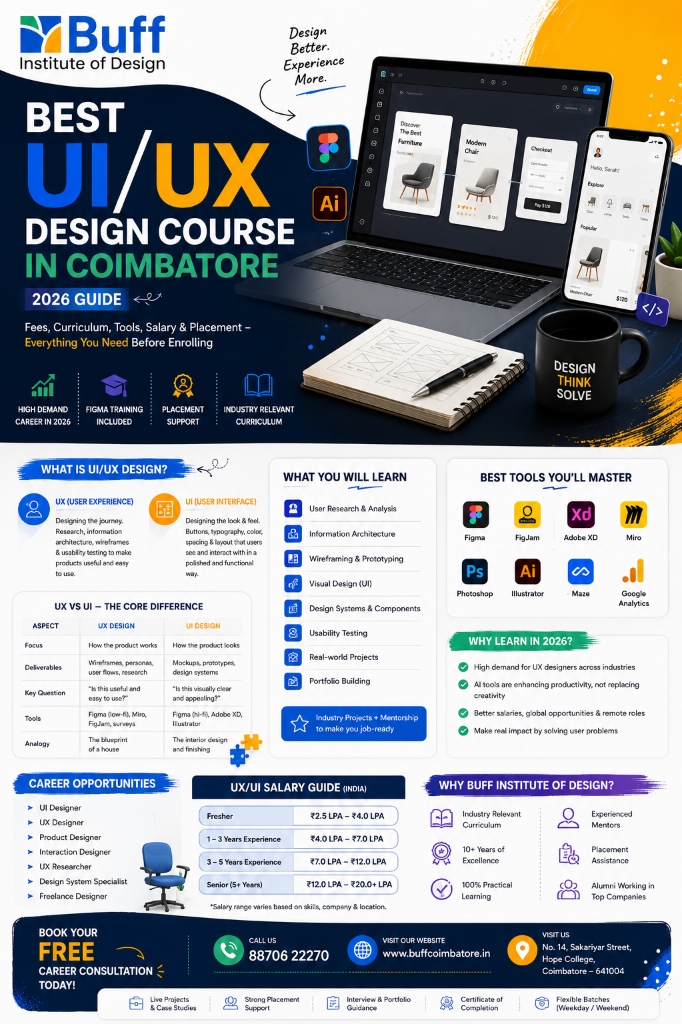
Featured Snippet — What is UX Design?UX (User Experience) Design is the process of designing digital products — apps, websites, and software — so that they are useful, easy to use, and satisfying for the person using them. It covers research, information architecture, wireframing, and usability testing.
Featured Snippet — What is UI Design?UI (User Interface) Design is the visual and interactive layer of a digital product — the buttons, typography, colour, spacing, and layout a user actually sees and taps. UI designers turn a UX designer's structure into a polished, functional screen.
If you've ever searched "UI UX Design Course in Coimbatore" or "UX UI Course in Coimbatore," you've probably also wondered what the two terms actually mean — and whether they're the same job. They're not, though they overlap heavily and most institutes (including product teams) expect designers to be comfortable in both.
What Is UI UX Design?
Explaining UX (User Experience)
UX design is about the journey, not the screen. A UX designer asks:
- Who is the user, and what problem are they trying to solve?
- What's the simplest path to get them there?
- Where do people get confused, frustrated, or drop off?
The output of UX work is usually wireframes, user flows, personas, and research findings — the skeleton a product is built on.
Explaining UI (User Interface)
UI design is about the look and feel. A UI designer asks:
- What should this button look like, and where should it sit?
- What colour palette and type system represents the brand?
- How do we make the interface feel intuitive at a glance?
The output of UI work is high-fidelity mockups, design systems, and interactive prototypes — usually built in Figma.
UX vs UI: The Core Difference
| Aspect | UX Design | UI Design |
|---|---|---|
| Focus | How the product works | How the product looks |
| Deliverables | Wireframes, personas, user flows, research | Mockups, prototypes, design systems |
| Key Question | "Is this useful and easy to use?" | "Is this visually clear and appealing?" |
| Tools | Figma (low-fi), Miro, FigJam, surveys | Figma (hi-fi), Adobe XD, Illustrator |
| Analogy | The blueprint of a house | The interior design and finishing |
Why Businesses Hire UX Designers
Companies aren't hiring UX designers because it's trendy — they're hiring because bad UX is expensive. A confusing checkout flow, an app nobody can navigate, or a form that takes ten minutes to fill directly costs revenue. Good UX designers reduce customer support tickets, increase conversion rates, and shorten the time it takes users to complete a task — which is why product companies, IT service firms, and even traditional Coimbatore manufacturing and textile businesses expanding into digital products are now budgeting for design talent.
Why Learn UI UX Design in 2026?
The Demand Is Still Rising
Every business with a website, app, or internal software tool needs someone to design the experience — that demand hasn't slowed down, even as the tools around design have changed.
The AI Impact — Threat or Tool?
A lot of students ask: "Will AI replace UX designers?" The honest answer is no — but it is changing how designers work. AI tools now:
- Generate first-draft wireframes and layout variations in seconds
- Summarise user research and interview transcripts
- Auto-generate UI copy and accessibility suggestions
- Speed up asset creation and image generation for mockups
What AI can't do is understand a specific user's frustration, negotiate trade-offs with a product manager, or make a judgment call about what to cut from a feature. Designers who learn to use AI as a speed multiplier — rather than fearing it — are the ones getting hired faster in 2026. A strong course today should teach Figma fundamentals and how to responsibly integrate AI tools into the design process.
Industry Trends Worth Knowing
- Design systems are now standard at mid-size and large companies — designers who understand components, variables, and reusable libraries are more employable.
- Accessibility (a11y) has moved from "nice to have" to a compliance requirement in many product companies.
- Remote and hybrid design roles are widely available — a Coimbatore-based designer can realistically work for a Bangalore, Chennai, or international product company without relocating.
Career Opportunities Beyond "Designer"
A UI UX qualification doesn't lock you into one job title. It opens paths into:
- Product Design
- UX Research
- Interaction Design
- Design Systems
- UX Writing / Content Design
- Freelance and consulting work
- Founder-track roles (many entrepreneurs learn UX to design their own MVP)
Why Coimbatore Is Becoming a UX Hub
Coimbatore's reputation as an engineering and textile city is well established — but it's quietly become a serious base for design and product talent too, for a few concrete reasons:
- Growing IT and product ecosystem: IT parks and SEZs around the city (including areas near Saravanampatti and Peelamedu) host a mix of established IT service companies and newer product startups, many of which now hire in-house design teams instead of outsourcing.
- Startup activity: Coimbatore's startup scene has expanded across fintech, edtech, healthtech, and D2C — and early-stage startups almost always need a generalist designer who can handle UX and UI together.
- Remote-first hiring: Because Bangalore- and Chennai-headquartered companies increasingly hire remote designers, Coimbatore-based talent can access big-city salaries without big-city living costs.
- Lower cost of quality education: Compared to metro design schools, Coimbatore institutes offer industry-relevant training at a fraction of the cost — making the return on investment on a UX course unusually strong here.
- Rising local salaries: As more companies compete for design talent in Tier-2 cities, starting salaries for junior UX/UI designers in Coimbatore have been trending upward year on year.
For students in Peelamedu, Saravanampatti, RS Puram, Gandhipuram, Avinashi Road, and across Tamil Nadu more broadly, this means a UX career no longer requires relocating to Chennai or Bangalore before you've even landed your first job.
How to Choose the Best UI UX Institute in Coimbatore
Not every "UI UX course" is built the same way. Before enrolling anywhere, evaluate the institute against these criteria:
- Curriculum depth — Does it cover research and strategy, or just Figma software training?
- Faculty background — Are trainers practising designers, or only trainers?
- Portfolio outcome — Will you leave with 3–5 real, presentable case studies?
- Live/real-world projects — Simulated briefs from actual business problems, not just tutorial clones.
- Placement support — Structured interview prep, resume/portfolio review, and employer connections — not just a vague "placement assistance" line.
- Industry mentors — Access to working designers who can review your work and give honest feedback.
- Tools taught — Figma and FigJam are non-negotiable in 2026; bonus points for AI-tool integration.
- Student reviews — Look for verifiable, detailed reviews rather than generic five-star ratings.
- Class size and mentorship ratio — Smaller batches generally mean more individual feedback on your portfolio.
- Career support after the course ends — Does support stop at graduation, or continue with referrals and interview practice?
Quick Comparison Checklist
| What to Check | Why It Matters |
|---|---|
| Curriculum includes research + IA, not just visual design | Employers hire "T-shaped" designers, not just Figma operators |
| Live client/industry projects | Portfolio quality is the #1 factor in getting shortlisted |
| Placement assistance is structured, not a one-line promise | Determines how fast you land your first role |
| Small batch sizes | More 1:1 portfolio feedback |
| Trainers are practising designers | Real-world insight, not just theory |
What a Good UX Curriculum Should Include
A course that only teaches "how to use Figma" will not make you employable. A complete curriculum should cover the full design process:
Research & Strategy
- User Research (interviews, surveys, competitive analysis)
- Personas
- Empathy Mapping
- Information Architecture (IA)
- User Flows
Design & Prototyping
- Wireframing (low-fidelity)
- Figma fundamentals
- FigJam for collaborative workshops
- Auto Layout
- Variables and design tokens
- Components and reusable libraries
- Responsive design across devices
- Accessibility standards (WCAG basics)
- Design systems
Validation
- Usability testing methods
- Iterating on feedback
- Case study writing
Career Readiness
- Portfolio building (3–5 polished case studies)
- Interview preparation and mock interviews
- Responsible use of AI design tools in the workflow
If a course skips research, information architecture, or usability testing and jumps straight to "make it look nice in Figma," it's teaching UI software skills — not UX design as a discipline.
UI UX Course Fees in Coimbatore
Course fees in Coimbatore vary depending on course depth, duration, and whether the program includes live projects, mentorship, and placement support. As a general guide for 2026:
| Course Type | Typical Duration | What It Usually Includes |
|---|---|---|
| Short workshop / certificate | 2–4 weeks | Basic Figma skills, no placement support |
| Comprehensive diploma/bootcamp | 3–6 months | Full curriculum, portfolio, live projects, placement assistance |
| Advanced/mentorship-driven program | 6+ months | Everything above + 1:1 mentoring, internship, deeper AI/tooling coverage |
A few things worth checking before comparing fees on price alone:
- EMI options: Most reputable institutes now offer no-cost or low-interest EMI plans, so upfront cost shouldn't be the only filter.
- Scholarships: Merit- or need-based fee waivers are increasingly common — always ask directly rather than assuming they don't exist.
- Value for money: A cheaper course with no live projects or placement support often costs more in the long run, since you'll need to invest extra time (or money) building a portfolio independently before you're job-ready.
For exact, current fee structures, request a syllabus and fee breakdown directly from the institute — fees are updated periodically and are best confirmed before enrolment.
Career Opportunities After a UI UX Course
A UI UX qualification opens doors to a wider range of roles than most students expect:
- UX Designer — owns research, flows, and wireframes
- UI Designer — owns visual design and prototyping
- Product Designer — owns UX + UI end-to-end, often with some product-strategy input
- Interaction Designer — focuses on micro-interactions, motion, and usability
- UX Researcher — specialises in interviews, testing, and data-driven insight
- Design System Designer — builds and maintains component libraries at scale
- Product Design Consultant — advises businesses on digital product strategy
- Freelance UX/UI Designer — works independently across multiple clients
Industries Hiring UX/UI Talent in and around Coimbatore
IT services, product startups (fintech, edtech, healthtech), D2C/e-commerce brands, textile and manufacturing companies building digital tools, and marketing/creative agencies expanding into UX-led web design.
UX/UI Salary Guide (Fresher to Senior)
Featured Snippet — How much salary does a UX Designer earn?In India, fresher UX/UI designers typically start in the entry-level salary band, with earnings rising steadily with 1–3 years of portfolio-backed experience. Senior and lead designers, along with remote/international roles, command significantly higher compensation — often multiples of a fresher's starting salary.
| Experience Level | General Trend |
|---|---|
| Fresher (0–1 yr) | Entry-level salary; varies by city and company size |
| 1–3 years | Noticeable jump once a strong portfolio and 1–2 shipped products exist |
| 3–5 years | Mid-to-senior band; specialisation (research, systems, product design) increases pay |
| 5+ years / Senior | Lead/Principal-level compensation, often with equity in startups |
| Remote / International clients | Frequently the highest-paying track for experienced Indian designers |
Note: Exact figures shift with market conditions, company size, and negotiation — treat this as directional guidance and verify current numbers via live job listings (LinkedIn, Naukri, AngelList) before making career decisions based on salary alone.
Skills Required to Become a UX/UI Designer
- Creativity — generating multiple solutions to the same problem
- Problem-solving — breaking down ambiguous business goals into design decisions
- Psychology/empathy — understanding how real users think and behave
- Research skills — interviewing, synthesising, and validating assumptions
- Communication — explaining and defending design decisions to stakeholders
- Collaboration — working closely with developers, product managers, and marketers
- Design thinking — structured approach to problem framing and iteration
Common Mistakes Students Make
- Learning only Figma shortcuts, not the design process behind them — tool fluency without process understanding doesn't hold up in interviews.
- Copying dribbble-style visuals without solving a real problem — recruiters can tell the difference between a "pretty screen" and a solved user problem.
- Skipping research and usability testing — most weak portfolios have zero evidence of a design decision being validated.
- Building too many shallow projects instead of 3–5 deep ones — quality of case studies matters more than quantity.
- Ignoring accessibility and responsive design — a common gap that experienced interviewers specifically probe for.
- Not documenting the "why" behind decisions — a portfolio without reasoning reads as decoration, not design.
- Underestimating interview prep — strong design skills alone don't guarantee offers; storytelling and critique-handling matter just as much.
Best Tools to Learn UX/UI Design
| Tool | Primary Use |
|---|---|
| Figma | Industry-standard UI design and prototyping |
| FigJam | Collaborative whiteboarding, workshops, journey mapping |
| Adobe Illustrator | Vector graphics and icon design |
| Photoshop | Image editing and visual asset preparation |
| Miro | Research synthesis, affinity mapping, workshops |
| Notion | Documentation, case study writing, project organisation |
| AI design/copy tools | Speeding up ideation, first drafts, and UX writing |
The Future of UX Design
Looking ahead, a few shifts are already reshaping how designers work:
- AI-assisted design workflows becoming standard practice rather than a novelty
- Voice UI growing alongside smart assistants and voice-first products
- AR/VR and spatial design opening new interface paradigms beyond the flat screen
- Design systems at scale, as more companies standardise components across products
- Accessibility as a baseline requirement, not an afterthought, driven by both regulation and user expectations
Designers who build a strong foundation in research, systems thinking, and tool fluency — rather than chasing whichever visual trend is popular this year — are the ones who adapt fastest as these shifts continue.
Why Buff Institute of Design Is a Leading Choice in Coimbatore
Choosing where to learn UX/UI design is as important as deciding to learn it at all — and Buff Institute of Design in Coimbatore is built around the exact criteria outlined in the checklist above.
- Industry-focused curriculum that goes beyond software tutorials into research, information architecture, and usability testing — not just "how to click around in Figma."
- Figma-based, hands-on training, reflecting the tool product teams actually use day to day.
- Real-world and live projects, giving students practical experience solving actual design briefs rather than only working from templates.
- Structured portfolio development, so graduates leave with case studies they can confidently present in interviews — not just a folder of screenshots.
- Placement assistance and career guidance, supporting students through the transition from classroom to job-ready designer.
- Access to industry mentors, offering the kind of practical feedback that's hard to get outside a working studio environment.
- AI-integrated learning, preparing students for a workflow where AI tools are part of the modern designer's toolkit rather than a threat to it.
If you're comparing UI UX institutes in Coimbatore, Buff Institute is a strong option worth evaluating closely — particularly for students who want a curriculum grounded in real design practice rather than software tutorials alone.
Frequently Asked Questions
1. What is UX Design?
UX (User Experience) Design is the process of making digital products useful, usable, and satisfying by focusing on research, structure, and the overall user journey.
2. What is UI Design?
UI (User Interface) Design is the visual and interactive layer of a product — layout, colour, typography, and the elements users directly interact with.
3. Is UX Design a good career in 2026?
Yes — demand for UX/UI talent remains strong across IT, product startups, and traditional businesses digitising their services, and the field offers flexible, often remote-friendly career paths.
4. How much salary does a UX Designer earn in India?
Salaries vary by experience, city, and company size, generally rising with portfolio strength and years of experience; freelance and remote/international work can pay significantly more than local entry-level roles.
5. What is the best UI UX course in Coimbatore?
The "best" course depends on your goals, but look for one with a research-driven curriculum, live projects, Figma training, portfolio development, and structured placement support — such as Buff Institute of Design.
6. How long does it take to become a UX Designer?
Most comprehensive courses take 3–6 months, though building genuine job-readiness (portfolio + interview skills) often takes a few additional months of practice.
7. Do I need a design degree to become a UX/UI Designer?
No — many successful UX/UI designers come from engineering, arts, commerce, or entirely unrelated backgrounds and transition through a focused course and strong portfolio.
8. Can I learn UI UX Design after engineering?
Yes — engineering graduates often transition smoothly into UX because of existing logical problem-solving and technical collaboration skills.
9. Can I learn UI UX Design after BSc, BCA, or MBA?
Yes — UX design is a skill-based field, so students from BSc, BCA, MBA, or diploma backgrounds regularly retrain successfully with the right course.
10. Is Figma necessary for UI UX Design?
Yes — Figma is the industry-standard design and prototyping tool used by most product companies today, making it essential for any serious UX/UI course.
11. What is the difference between UX and UI Design?
UX focuses on how a product works (structure, flow, usability); UI focuses on how it looks and feels (visuals, layout, interactivity).
12. What tools do UX/UI Designers use?
Commonly Figma, FigJam, Adobe Illustrator, Photoshop, Miro, and increasingly AI-assisted design tools.
13. Can I become a UX Designer without coding knowledge?
Yes — coding isn't required, though a basic understanding of how developers implement designs helps in collaboration.
14. What is a UX portfolio, and why does it matter?
A UX portfolio is a curated set of case studies showing your design process and decisions; it's typically the single most important factor in landing interviews.
15. How many projects should be in a UX portfolio?
Quality matters more than quantity — 3 to 5 deep, well-documented case studies are generally stronger than ten shallow ones.
16. What is the average class size in a good UI UX institute?
Smaller batch sizes generally mean more individual mentorship and detailed portfolio feedback — worth asking about directly when comparing institutes.
17. Does Buff Institute of Design offer placement assistance?
Yes — Buff Institute provides structured placement assistance and career guidance as part of its UI UX program.
18. What is included in the UI UX course fee?
Typically curriculum access, tool training, live projects, mentorship, and placement support — always confirm the exact inclusions and current fee structure directly with the institute.
19. Are EMI options available for UI UX courses in Coimbatore?
Many institutes, including Buff Institute, offer EMI options to make courses more accessible — confirm current plans during enrolment.
20. What is Design Thinking?
Design Thinking is a structured, user-centred problem-solving approach involving empathising, defining, ideating, prototyping, and testing.
21. What is a Design System?
A design system is a reusable library of components, styles, and guidelines that ensures visual and functional consistency across a product.
22. Is remote work possible as a UX/UI Designer based in Coimbatore?
Yes — many Coimbatore-based designers work remotely for companies in Bangalore, Chennai, and internationally, especially once they have a strong portfolio.
23. How is AI changing UX/UI design careers?
AI is speeding up tasks like wireframing, research synthesis, and asset generation — designers who learn to use AI tools effectively tend to work faster and stand out to employers.
24. What is UX Research, and is it a separate career?
UX Research focuses specifically on understanding user behaviour through interviews, testing, and analysis — it can be a standalone specialisation or part of a broader UX role.
25. What is Interaction Design?
Interaction Design focuses on how users interact with a product's specific elements — buttons, transitions, and micro-interactions that shape the feel of using it.
26. Can freelancers benefit from a UI UX course?
Yes — a structured course helps freelancers formalise their process, build a stronger portfolio, and justify higher rates to clients.
27. What career support does Buff Institute of Design offer after the course ends?
Buff Institute offers ongoing career guidance and placement assistance to help graduates transition into their first UX/UI roles.
28. Where is Buff Institute of Design located in Coimbatore?
Buff Institute of Design is based in Coimbatore, serving students from across the city and neighbouring regions including Peelamedu, Saravanampatti, RS Puram, and Gandhipuram.
Book Your Free Career Consultation
Choosing the right UI UX design course is one of the biggest career decisions you'll make this year — and the right guidance makes all the difference.
Ready to take the next step?
- Book a free career consultation with Buff Institute of Design's admissions team
- Download the full UI UX syllabus to see exactly what you'll learn, week by week
- Visit Buff Institute of Design in Coimbatore to tour the campus and meet the mentors